By Omar Afra
PERUSE THE INCOMPLETE BUT GROWING ARCHIVE HERE
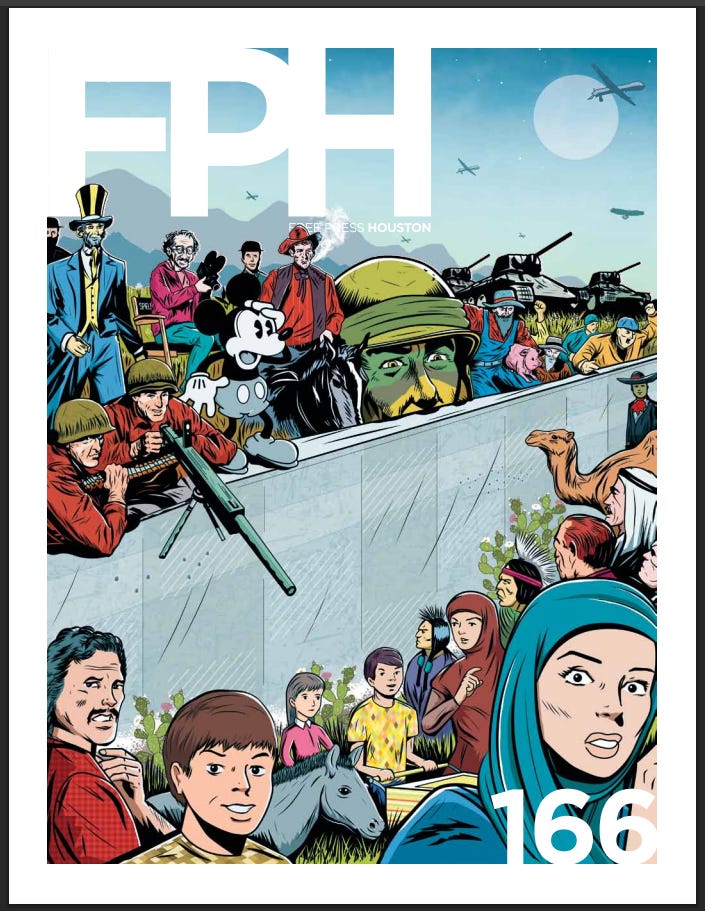
When Free Press Houston dissolved, losing the archive was one of the great disasters of the whole thing. Fifteen years of newspapers, articles, artwork, photography, festival material and assorted Houston cultural debris ended up scattered across dead websites, forgotten drives, abandoned email accounts and whatever print issues happened to survive. At the time I was far too close to the wreckage to have any interest in digging through it. Enough time has passed that I can finally look at the material for what it is: a huge record of Houston cultural life between 2003 and 2018 that very nearly disappeared.
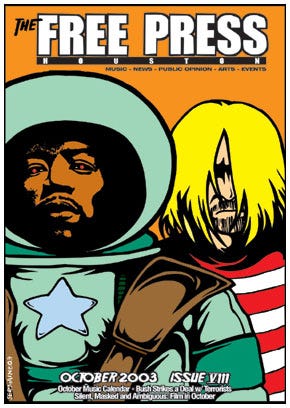
So I’ve been rebuilding it. The Free Press Houston Archive started with recovering newspaper PDFs and quickly turned into something considerably more ridiculous. Articles are being reconnected to their writers and artists, covers to issues, photographs to events, and old festival maps, schedules, posters and production material to the years in which they actually existed. What looked at first like a pile of files has gradually revealed just how much shit we made.
The newspaper itself was only part of it. The archive now reconstructs the history of Free Press Summer Fest, from its early years at Eleanor Tinsley Park through the considerably larger beast it became; Day for Night, the music-and-digital-art festival we built around large-scale installations, light and generative work; and the Westheimer Block Party, which began with the fairly modest idea of putting some life back onto Westheimer and eventually involved stages, clubs, parking lots and thousands of people spread around Montrose. There is also a growing record of HOU Decide, our experiment in turning Houston mayoral politics into something resembling an actual public event.
Putting everything next to everything else has been strange. When you are actually producing a newspaper or a festival, you mostly remember the effing problems: under-capitalization, deadlines, printers, permits, stages, bands, weather, money and the thousand other small emergencies trying to eat your day. Did I mention under-capitalization? Looking at it years later, what is much more obvious is the sheer amount of work produced by an enormous group of writers, illustrators, photographers, editors, designers and assorted street-urchins who kept showing up and making things despite ambiguous compensation and a thankless readership.
The reconstruction is intentionally AI constructed and evidence-driven. If a date is known from an original issue, use the date. If an artist is credited, credit them. If we do not know who made something, we don’t suddenly discover their identity through the miracle of SEO. Old PDFs, mastheads, original web pages, photography, artwork, posters and contemporary records are doing most of the talking. There are still holes everywhere, and there probably always will be, but considerably more survived than I ever expected.
That has become the simple purpose of the project: recover what we can, identify it correctly, credit the people who made it and put it somewhere it is less likely to disappear again. Houston has always had a tremendous capacity to build interesting things and then bulldoze, forget or misplace the evidence. This is one small attempt to make that a little harder.
You can start anywhere at the Free Press Houston Archive, although fair warning: there is now enough material to remind you how hard editing was prior to AI when humans, often stoned, had to catch the endless cacophony of typos — most of which were mine. In fact, most of all the failures were mine. Digging through 15 years worth of archives have made that clear and digging up so many bones has burned me on any nostalgia that had remained. Either way, all the great work from so many people had to be archived and preserved. Frankly, the body of work is astounding and day for Night was truly a game-changer. Couldn’t be prouder despite crashing the plane into the side of the mountain.