
BY OMAR AFRA
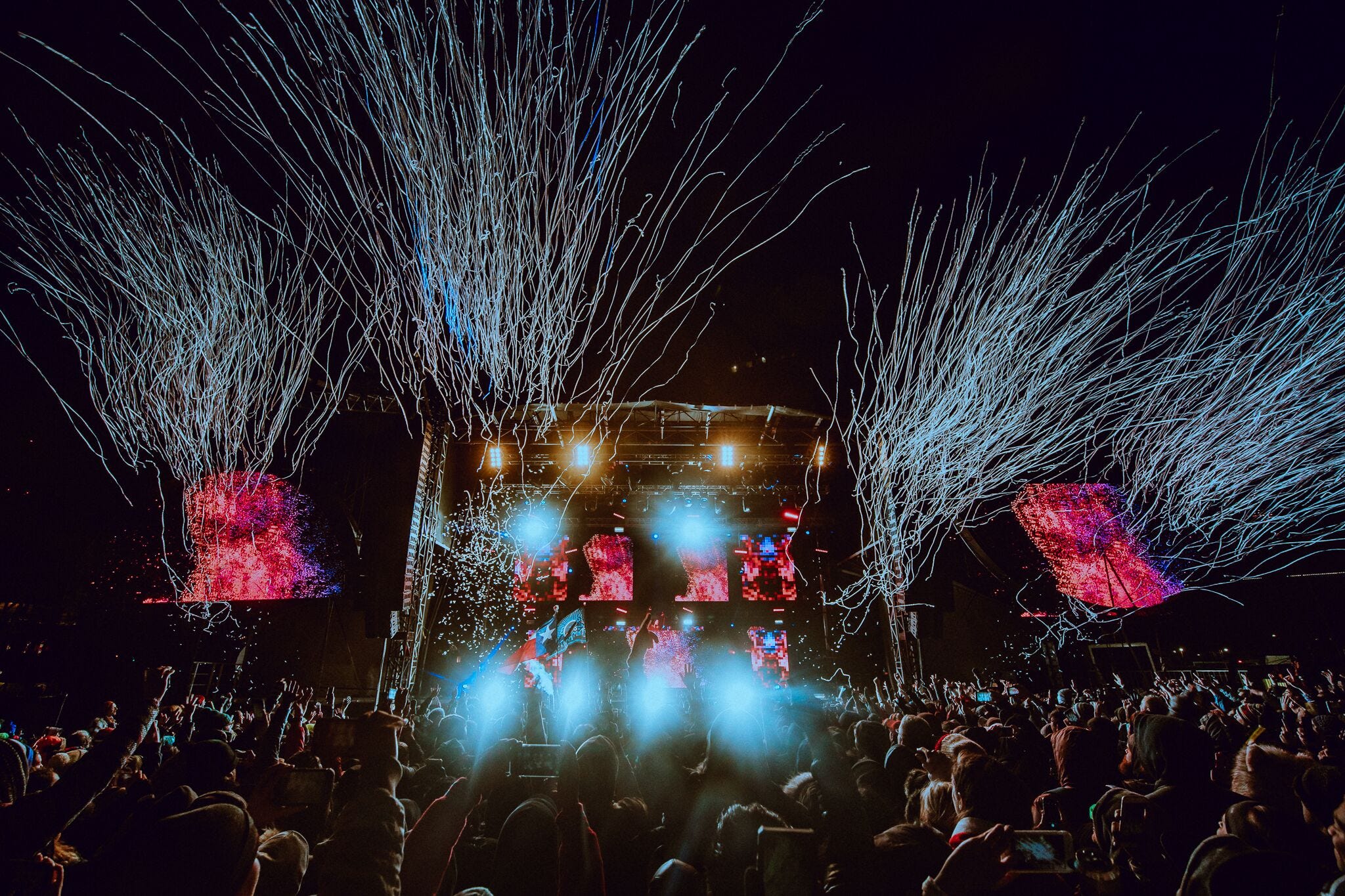
The problem with remembering a festival like Day for Night is that everybody remembers the sexy shit: Aphex Twin playing in the rain, Björk, lasers moving through a dark warehouse, Ryoji Ikeda rattling somebody’s nervous system, Nine Inch Nails against the Houston skyline, tens of thousands of people wandering around a dead post office wondering what exactly they had gotten themselves into. I remember those things too. I also remember forklifts, electrical drops, barricades, invoices, missing radios, people asking for things that did not exist in Texas and the peculiar festival-production experience of discovering at 3 p.m. that somebody has made a promise involving several tons of equipment and a part of the building that cannot hold several tons of equipment.
That is partly why the newly reconstructed Day for Night collection at the Free Press Houston Archive interests me more than another victory lap about the festival. The archive now brings together all three Day for Night editions, 32 recovered Free Press Houston articles, site plans, schedules, photographs, production material, staff records and a separate archive devoted to the art of Day for Night. It is increasingly possible to look at Day for Night as a documented thing instead of a fog of old Instagram posts and exaggerated memories.
I recently wrote a more personal account, “Omar Afra on Day for Night and Houston’s New-Media Art Moment”, about where the idea came from and why new-media art became so important to it. Going back through the actual records raises another question that I find harder and probably more useful: should Day for Night have happened in Houston at all? I don’t mean whether Houston was cool enough. That is a tedious question usually asked by people who think culture arrives through airport codes. I mean something more practical. Who was the festival actually for? Who bought the tickets? What did Houston provide? Was the city the audience, or was Houston itself part of the medium?
By October 2016, before the second edition had even happened, 75 percent of Day for Night ticket sales were coming from outside Houston. Free Press Houston published that number at the time, and contemporary reporting described buyers coming from elsewhere in the United States and as far away as Europe and Asia. Our final promoter-side ticketing numbers were less extreme but still pretty remarkable: roughly 16,000 tickets were sold to buyers outside Houston, versus about 8,000 to Houstonians. I am identifying those as our own internal ticketing figures rather than pretending they were some university study. The earlier public 75-percent number and our final numbers measure different moments in the sales cycle, but they tell the same basic story: most of the people buying tickets to one of Houston’s most talked-about cultural events were not from Houston. That still fucks with me a little.
The 2015 edition of Day for Night had already sold out with roughly 20,000 attendees. The next year we moved from Silver Street Studios into the former Barbara Jordan Post Office at 401 Franklin, a 1.5-million-square-foot federal sorting facility downtown. The 2016 plan called for three major performance stages, large interior art environments and more than 35,000 square feet devoted to Björk Digital alone. General admission initially started around $150; packages including the Friday preview began around $250, and VIP reached $700. This was not a modest regional arts event. It was a fairly aggressive bet on whether people would travel to Houston for something they could not easily get anywhere else.
Houston was essential to the proposition precisely because it had things that other cities did not. We had enormous industrial buildings sitting around in various states of neglect, a cheaper cost structure than New York or Los Angeles, a city accustomed to petrochemical infrastructure and large-scale fabrication, and people who knew how to solve physical problems without needing to issue a manifesto about it first. We also had an audience that was less culturally conservative than outsiders assumed and an arts community comfortable operating between institutions, warehouses, clubs and improvised spaces. Most importantly, Houston had room.
Before anybody turned the old post office into POST Houston with restaurants, polished concrete, landscaping and a rooftop garden, it was basically an abandoned federal machine: huge sorting floors, loading docks, utility corridors, columns, dark rooms and exterior acreage. The normal response to seeing a building like that is probably “redevelopment opportunity.” Our response was closer to “Where can we put the lasers?” The Day for Night archive now preserves enough site documentation, photography and production material that the building itself begins to read as one of the central characters in the story.
The building changed the possibilities of the festival, but the idea had already been established in 2015 at Silver Street Studios with a serious visual program in place: Refik Anadol’s Infinity Room, Casey Reas, NONOTAK, Zach Lieberman, Joanie Lemercier, Vincent Houzé with AV&C, the School for Poetic Computation and others. The idea from the beginning was that art would not live in a humiliating little side tent called the “Art Zone” while the real festival happened fifty yards away. Alex Czetwertynski curated a program built around light, code, projection, spatial sound, interaction and computation; Kiffer Keegan and I developed the broader creative premise; Chris Wise and I worked on the music programming. The reconstructed Art of Day for Night collection now lets you move through those works edition by edition instead of treating them as decorative footnotes to the lineup.
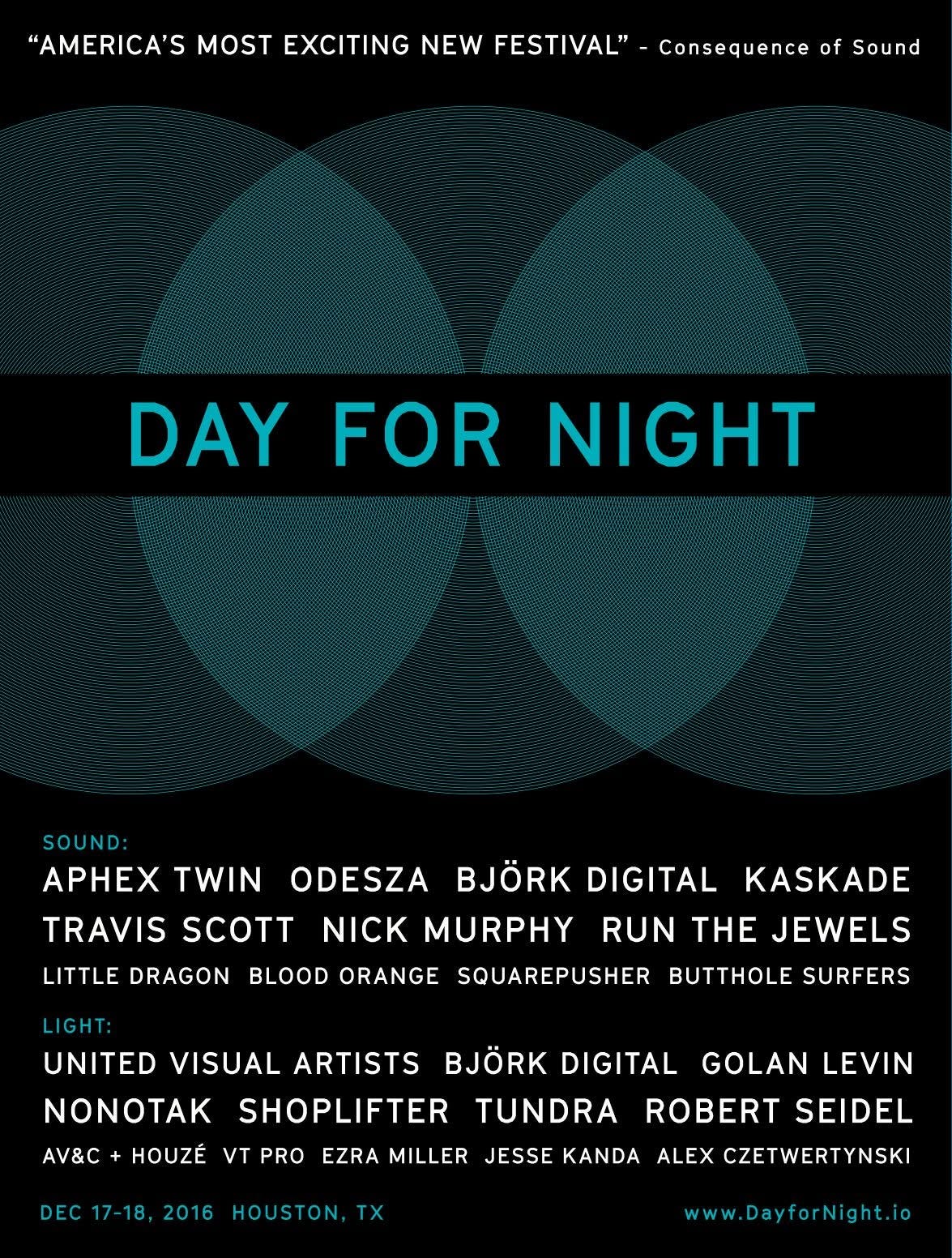
By 2016 the scale went nuts. United Visual Artists presented Musica Universalis. TUNDRA built Outlines. Shoplifter and Endless Collective made Ghostbeast. AV&C and Vincent Houzé created Phases. NONOTAK returned. Golan Levin was there. Damien Echols created Crimson Lotus. Björk Digital occupied tens of thousands of square feet inside the building. Contemporary Free Press Houston coverage of the art program made a point of telling readers that the work was not decorative filler. The Day for Night art archive now makes it possible to see the installations as a coherent curatorial program rather than a pile of cool old photographs.
That distinction mattered because we were not trying to persuade somebody who had come to see Aphex Twin to stop by an art gallery as an act of civic virtue. We wanted them to walk around a corner and get punched in the brain by something they did not expect. The music helped make that possible because the 2016 lineup was absurd: Aphex Twin, Björk, ODESZA, Kaskade, Travis Scott, Butthole Surfers, Squarepusher, SOPHIE, Arca, Run the Jewels and plenty more. The archived 2016 lineup coverage captures how outrageous the announcement felt at the time. Aphex Twin’s appearance was especially important because it was his first U.S. performance in years, and a meaningful portion of the audience was clearly traveling to Houston specifically for the festival.
That brings me back to whether Day for Night should have happened here. Maybe Houston was not merely the market; maybe that was the point. If roughly twice as many ticket buyers were coming from outside Houston as from inside it, Day for Night was functioning partly as cultural tourism. People were getting on airplanes to see Aphex Twin, Björk and a bunch of computational art inside an abandoned Houston post office. The thing attracting them was not simply a lineup that could have been dropped into a field outside Chicago. The city, the building and the strangeness of the setting were part of what people were buying.
There is some economic evidence for that, although it needs to be treated carefully. A later Houston retrospective referred to a study estimating that Day for Night 2016 generated nearly $20 million for Houston. The underlying study has not yet been recovered, so Live Index treats the figure as a secondary reference rather than a hard audited result. We should not pretend to know its methodology or economic boundary. Combined with the ticket-origin data preserved alongside the broader Day for Night historical record, however, the basic mechanism is easy enough to understand: thousands of people were coming into Houston, staying somewhere, eating somewhere, drinking somewhere and spending money because the festival gave them a reason to be here.
The other side of the economics is less romantic. In a 2019 interview I estimated that Day for Night cost roughly $6 million to $7 million per edition, and I said none of the three editions was profitable. That is my account, not an audited financial statement, and it should be read as such. But it matters because mythology has a tendency to convert ambitious cultural projects into evidence that somebody discovered a magical business model. We did not. We built an extraordinary festival and spent an extraordinary amount of money doing it. Those are not the same thing as building a sustainable business, which is probably the most useful answer to anyone who wonders why nobody simply recreated Day for Night afterward. It was fucking expensive.
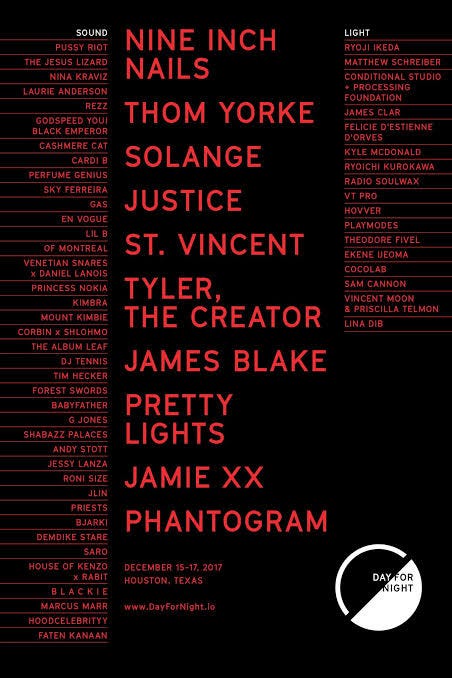
By the third Day for Night edition in 2017, the project had become something even stranger. The music program included Nine Inch Nails, Thom Yorke, Solange, Justice, St. Vincent, Tyler, the Creator, James Blake, Jamie xx and others, while the visual program included artists such as Ryoji Ikeda, Matthew Schreiber and Félicie d’Estienne d’Orves. The opening-day summit brought together Chelsea Manning, Laurie Anderson, Pussy Riot’s Nadya Tolokonnikova and Lauren McCarthy, and a portion of proceeds went toward Hurricane Harvey relief after the storm devastated Houston only months earlier. The 2017 material preserved in the archive makes clear just how far the festival had wandered from the conventional boundaries of a music event.
The surviving December 2017 production grid gives an even less glamorous sense of scale. The stages were marked with capacities of roughly 17,000 for Red, 9,000 for Green, 6,000 for Blue and 2,000 for Yellow. Those are not attendance counts; they are production-planning capacities. But they tell you what kind of temporary machine was being assembled inside and around that post office, and they are precisely the sort of records that make the Free Press Houston Archive’s Day for Night collection more useful than a retrospective assembled from memory alone.
By then national press had begun treating Day for Night less as another stop on the festival calendar and more as an example of where the form itself might go. Pitchfork examined the growing overlap between visual art and music festivals through Day for Night, while Consequence of Sound named the 2017 edition Festival of the Year. This is where mythology starts getting dangerous because the story becomes suspiciously tidy afterward: Houston newspaper guy has crazy idea, international artists descend on town, critics lose their minds, Festival of the Year, roll credits. Real life was much less cinematic.
The creative premise might be easy to summarize around a handful of names—Kiffer, Alex, Chris and me—but the actual festival existed because hundreds of people built stages, managed sites, installed art, ran technical systems, coordinated artists, handled operations and solved an endless chain of physical problems. One of the most useful parts of reconstructing the Day for Night archive has been restoring those people to the record instead of allowing festival mythology to compress the work into a few names and a poster.
The archive also keeps revealing how selective memory is. I remember the giant moments, while the record preserves things like site-map revisions, staff schedules, artist interviews, operating documents and production grids. That material is less glamorous, but it is often more revealing because culture is usually built out of mundane decisions before it becomes a photograph somebody posts ten years later and captions “legendary.” I am increasingly interested in the production records sitting beside the photographs and essays in the Day for Night collection because they force memory to answer to paperwork.
I am suspicious of nostalgia anyway, particularly my own. Everybody remembers Aphex Twin playing in a storm, but nobody remembers the restroom count. Everybody remembers Refik Anadol, while very few people remember the certificate of insurance. Nostalgia is basically what happens when the porta-potties have been edited out of the documentary.
So when I ask whether Day for Night should have happened in Houston, I think the answer now is yes, but not for the usual civic-booster reasons. Houston made the contradiction possible. It was a city with an enormous arts community and a persistent insecurity about whether outsiders considered it an arts city, a place that could contain both the Rothko Chapel and somebody fabricating a steel structure in a shop off the freeway at 3 a.m. Its great advantage has always been that there is enough physical and cultural room for people to get away with things before anyone forms a committee to stop them. Day for Night was built out of that.
The fact that thousands of people had to come from outside Houston to fill it does not weaken the argument; it may actually be the argument. In 2016, Houston was not merely producing a festival for Houstonians. It was exporting a cultural idea and making people travel here to experience it. For a city that has spent decades complaining that Austin gets too much credit, that New York does not pay attention and that Los Angeles thinks everything between itself and Brooklyn is a connecting flight, getting thousands of people to willingly board airplanes for an experimental art-and-music festival in an abandoned post office seems like a reasonably effective response.
None of this means Day for Night was flawless. It was operationally difficult, financially brutal and occasionally an extremely expensive method for discovering that an idea was stupid. It also created some things that I have never seen replicated in quite the same way, which is why I prefer the archive to the mythology.
The mythology reduces Day for Night to a handful of spectacular memories. The archive is messier and more useful because it places the artists, lineups, ticket prices, site plans, staff records, photographs, articles and production documents beside the financial claims and audience numbers, including the ones that deserve caveats. The main Day for Night collection, the Art of Day for Night exhibition, and the retrospective on Day for Night and Houston’s new-media art moment together provide something we did not have while actually making the festival: enough distance and enough documentation to understand what the hell happened.
For three years, we took money, electricity, concrete, software, ego, talent, weather, forklifts and several thousand feet of cable and tried to make something that did not already exist. Sometimes it worked beautifully and sometimes it barely worked, with a surprising amount of overlap between the two. I remain proud that we were dumb enough to try it, and now, at least, the receipts are online.
Explore the complete Day for Night archive and browse the reconstructed Art of Day for Night collection.